Battle Bag: War Zone
- 4.0
- Rating
- 1.00M
- Installs
- Free
- Price

 Analysis by App-foxy
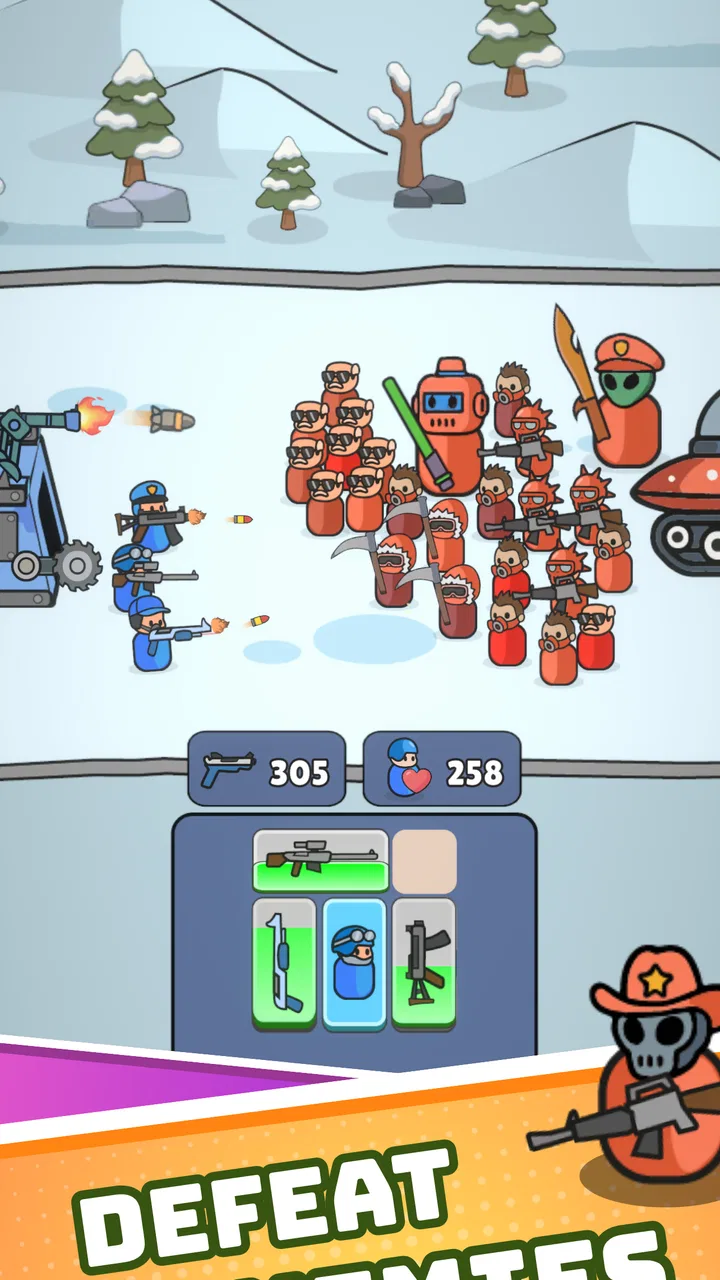
Battle Bag: War Zone is the kind of strategy game I open when I want a quick decision-making challenge rather than a long campaign. Its central idea is easy to understand: your backpack becomes the space where you prepare for combat, and the way you arrange what you carry affects how well you handle incoming enemies. That simple setup gives each run a useful layer of planning before the action becomes hectic.
I found it immediately approachable, but not completely mindless. The first few encounters teach the basic rhythm quickly, while later situations ask me to think more carefully about what deserves space and what can be left behind. It is free to play, developed by VOODOO, and listed in the strategy category. The game carries a Teen content rating, so I would not treat it as a child-focused puzzle title even though the controls are easy to pick up.
After spending time with it, my view is that Battle Bag: War Zone works best as a compact planning game for short sessions. It is a good fit for someone who enjoys arranging resources, reacting to pressure, and improving a repeatable routine. It is less suitable if you want a deep story, a large map to explore, or the kind of strategy game where every decision unfolds over a long uninterrupted match.
You May Also Like

 Blood Strike: 2.5 Anniversary
Blood Strike’s Loadouts Turn Every Drop Into a Tactical Gamble
A close look at Blood Strike’s custom loadouts: how fast access to signature weapons reshapes its battle royale rhythm, rewards preparation, and narrows the gap between fights.

 Pandora - Music & Podcasts
Pandora’s Music Is Easy to Start, but Harder to Recover
Pandora’s strength is its low-effort path from a seed to a station. Its weak spot is how much confidence it asks you to place in connection, setup, and quiet recovery.

 8 Ball Pool
 Is Built on Rivalries, Rematches, and Routine
A close look at the rivalries, rematches, shared routines, and unanswered safety questions that turn a quick pool match into a persistent mobile community.

 Samsung Music
’s Quiet Strength Is Playing What You Already Own
Its reach comes less from spectacle than from dependable access to a personal library. That simplicity is both the app’s strongest retention engine and its ceiling.

 AccuWeather: Weather Radar
AccuWeather Review: A Quick, Clear Forecast for Everyday Decisions
For everyday plans, the best forecast is the one you can understand quickly. AccuWeather makes rain timing, radar, and local conditions easy to act on, with a few trade-offs.

 Hill Climb Racing
Why Hill Climb Racing Still Turns Crashes Into One More Run
A tiny car, a bumpy hill and one more upgrade: Hill Climb Racing keeps resurfacing because its simple chaos makes every near-miss feel personal.
More From Our News Desk



How I play a normal run from preparation to pressure
I find that a run is easier to understand when I treat preparation and combat as two linked stages, rather than trying to solve everything at once. I settle on one clear purpose for the backpack, then watch for the moment that plan starts to strain; that gives me a useful cue for the next section’s reading and navigation habits.
The backpack is the real starting point
My normal workflow begins before I focus on the enemies. I first look at the available space and decide what the loadout is trying to accomplish. A crowded backpack can look powerful, but it can also make the arrangement harder to read and leave less room for a useful adjustment later. I prefer to begin with a clear plan rather than fill every opening automatically.
That habit matters because the backpack is not just an inventory screen. It is the main strategic surface of the game. Every item I place represents a choice about future flexibility. If I commit too early to one arrangement, I may have trouble responding when the wave becomes more demanding. If I leave too much unused space, I may be wasting potential. The best balance changes from run to run, which keeps the preparation phase from feeling entirely solved.
Once combat starts, I watch the result of that preparation instead of constantly trying to rebuild everything in my head. I pay attention to which parts of the setup are doing useful work and which ones seem to be taking space without improving the situation. This gives the run a practical feedback loop: prepare, observe, adjust, and try again with a more deliberate layout.
Why short sessions suit the design
I can see myself playing this during a commute, while waiting for food, or between larger tasks. The game does not require the same uninterrupted attention as a traditional grand strategy title. A short session can still contain a meaningful choice because the question is not simply whether I can tap quickly; it is whether I understood the relationship between my arrangement and the pressure coming toward me.
A realistic example is a late afternoon break. I might have only a few minutes, so I start a run with a familiar setup instead of experimenting with everything. If the result is poor, I do not need to spend a long time recovering. I can identify one weak point, change the layout, and test that idea on the next attempt. That makes failure useful rather than exhausting.
The trade-off is that the compact format can feel repetitive if I expect constant novelty. The satisfaction comes from refining choices, not from discovering a completely different world every time. Players who enjoy small improvements and repeatable challenges will probably get more from it than players who need a strong narrative reason to continue.
My first rule for arranging a loadout
I avoid making changes just because an item looks attractive on its own. I ask what role it serves in the entire backpack. A strong-looking addition is not automatically valuable if it disrupts the arrangement or prevents a more dependable combination. This is one of the first lessons I would give a friend: judge the space as a system, not as a collection of isolated prizes.
I also try to remember what caused trouble in the previous attempt. If the problem was poor early stability, I do not respond by adding unrelated options simply because they are available. I change one part of the plan and see whether that addresses the actual weakness. This makes progress easier to understand and prevents the backpack from becoming a random pile of hopeful choices.
Settings and habits that make the game easier to read
I get more from the game when I make the screen and my play space comfortable before a run begins, especially if I am using a smaller phone or playing somewhere distracting. A familiar layout and fewer avoidable interruptions can make choices easier to track, while the next section looks at the practical habits that help keep attention on the action.
Check the basics before blaming the strategy
Before settling into repeated runs, I would open the available settings and check the controls, sound, and display-related options that the current device presents. I do not assume that a default setup is ideal for every phone. A game built around quick visual decisions benefits from a screen that is comfortable to read and controls that do not feel awkward during one-handed play.
I keep the audio at a level where it supports the action without becoming tiring. If I am playing in public, I lower it rather than letting sound distract me from the visual flow. At home, I may leave more audio enabled because it helps separate the preparation phase from the active wave. These are small choices, but they affect how long I can play without feeling overloaded.
I also check whether notifications or other interruptions are likely to cover the screen. This is especially useful on a smaller display. When the backpack is the focus, even a brief interruption can make me lose track of what I was trying to arrange. I would not call this a special feature of the game; it is simply a sensible routine for a title that depends on visual organization.
Use a repeatable starting layout
Experienced play is less about finding a magical arrangement and more about reducing unnecessary decisions. I like to begin with a repeatable starting layout whenever the available choices allow it. That gives me a baseline. If a run goes badly, I can identify the change that mattered instead of wondering whether the entire setup was different.
This approach is particularly useful for new players who feel that every attempt is chaotic. I recommend keeping the early backpack simple, remembering the general position of the most important pieces, and changing only one or two decisions at a time. It may feel slower than constantly rebuilding, but it teaches the game’s logic much faster.
Another useful habit is to pause mentally before accepting a new item or rearrangement. I ask whether it improves immediate survival, creates a better future option, or merely looks interesting. If it does none of those things, I treat it as a distraction. That short question has helped me avoid many impulsive choices.
Settings cannot solve a crowded strategy
It is worth being clear about the limit here: better sound or display choices will not fix a poor backpack. They can make the game more comfortable, but the main difficulty remains organizational. If I am losing because the loadout has no coherent purpose, changing the volume will not help. I see settings as support for good decisions, not a substitute for them.
This distinction also answers a common concern about whether the game is suitable for casual players. Yes, the entry point is casual, but the best results come from treating each run as a small experiment. Someone who wants to tap through without considering placement may enjoy the first impression but could lose interest when the pressure rises.
Faster patterns that improve decision-making
I have found that faster choices come from using a few repeatable questions, not from rushing through each decision. Checking whether a choice supports the current plan, preserves flexibility, or simply adds clutter gives me a quick filter; the next section turns that filter into patterns I can apply without overthinking every run.
Sort by purpose before chasing variety
When I want to play faster, I do not try to inspect every possibility with equal attention. I group my thinking by purpose. I look for what helps me handle the immediate wave, what supports the next stage of the run, and what is only attractive because it is new. This mental sorting reduces hesitation and makes the backpack easier to understand at a glance.
The important insight is that speed comes from preparation, not frantic reactions. If I already know which spaces are reserved for the core of my setup, I can evaluate new choices quickly. I am not rebuilding the entire backpack every time something changes. I am checking whether the new option fits the plan or deserves a deliberate redesign.
I also avoid moving several pieces at once unless the current arrangement is clearly failing. Large changes make it difficult to learn from the result. A smaller adjustment may not produce a dramatic improvement, but it tells me more about the game and helps create a reliable pattern for future attempts.
Keep a fallback instead of filling every opening
One of my more useful habits is leaving room for a fallback. A completely packed backpack can appear efficient, yet it may leave no practical way to respond when the run asks for something different. I would rather preserve a little flexibility than squeeze in an option that only helps under ideal conditions.
This does not mean empty space is always good. Unused room has an opportunity cost, and a player who leaves too much of it will probably feel underprepared. The point is to keep enough freedom for correction. I think of it as insurance: it may not help during a smooth run, but it becomes valuable when the initial plan meets resistance.
This is also where the game separates itself from a simple reflex title. The fastest player is not necessarily the one who acts most quickly. It is often the player who has already made the important decisions before the pressure arrives.
Use failed runs as controlled tests
When a run ends badly, I try not to label the whole setup as useless. I identify the earliest moment when the plan stopped working. Was the backpack too specialized? Did I spend space on a choice that never became relevant? Did I make the arrangement difficult to read? These questions turn a loss into a practical next step.
I recommend changing one major variable at a time. If I alter the layout, the selection, and the overall approach together, the next result may improve but I will not know why. Controlled testing is more satisfying and eventually produces a personal playbook. That is one of the strongest non-obvious reasons to keep returning: the game rewards memory and discipline as much as immediate reaction.
Know when to stop optimizing
There is also a point where optimization stops being fun. I do not want every short break to become a serious analysis session. If I have found a comfortable setup, I sometimes play it without trying to improve it. That keeps the game relaxing and prevents the strategy layer from turning into homework.
On the other hand, when I am in the mood to learn, I deliberately choose a less familiar arrangement and observe the consequences. Having both modes is important. The game can serve as a light time-filler or as a small systems puzzle, depending on how much attention I bring to it.
Where the strategy reaches its limits
I enjoy the focused backpack puzzle, but it has a narrower range than a full strategy campaign, and that difference matters when choosing what to play. I would use it for short planning sessions rather than expecting broad exploration or a long-form story; the next section weighs those boundaries against the people and situations the game serves best.
The free entry comes with a spending decision
The game is free to download, but it includes in-app purchases ranging from under a dollar to amounts approaching fifty dollars per item. That does not automatically make it unsuitable, but it is something I would consider before handing the phone to a younger player. I would keep purchase controls protected, especially because the Teen rating already signals that this is not designed as a preschool experience.
For me, the right approach is to treat purchases as optional rather than part of the basic reason to try the game. I would first decide whether the core backpack-and-wave loop is enjoyable on its own. If it is not, spending more will not repair that mismatch. Players who prefer games with no purchase prompts at all may be happier with a paid strategy title or a simpler offline puzzle.
The presence of purchases also changes how I evaluate progress. I pay attention to whether I am improving because I understand the arrangement better or because I am relying on an easier route. That distinction matters to players who enjoy mastery. If your personal goal is learning the system, keep your decisions consistent and judge success by better planning, not only by reaching a stronger result.
It is not a replacement for a full strategy game
Compared with a traditional strategy game, Battle Bag: War Zone is much more focused. It does not offer the same kind of broad map control, diplomacy, technology planning, or long-term empire management that I expect from a desktop or console strategy experience. Its strength is concentration: one backpack, one combat problem, and a series of decisions that must fit inside a smaller frame.
Compared with a typical action game, it asks me to think more before reacting. Compared with a pure puzzle game, it introduces pressure and uncertainty through enemy waves. That middle ground is the reason I find it appealing. It gives me enough structure to plan without demanding a long evening, but it cannot provide the depth of a larger strategy system.
I would skip it if my priority is a story-driven adventure, competitive multiplayer, or a highly detailed simulation. I would also hesitate if I dislike repeating similar situations to refine a solution. The game’s appeal depends on accepting that repetition is part of the learning process rather than expecting every session to deliver a new type of content.
Device expectations and version context
The current version is 1.90.0, and the listed minimum operating system is Android 8.0. That makes the compatibility requirement fairly approachable for many Android users, although the actual comfort of play still depends on screen size, touch response, and how easily the backpack can be read on a particular phone. I would check the device experience early rather than assuming every screen will feel identical.
The game was released on April 25, 2025, and its audience has already grown beyond a small experiment: it has over one million installs. Its average rating is 4.1 from around 8,000 ratings, with several hundred written reviews. I read those figures as a sign of solid interest rather than universal agreement. The game clearly connects with many players, but the rating also fits my own impression that its short-loop design will not suit everyone.
My verdict after building a reliable routine
Battle Bag: War Zone succeeds when I treat it as a focused strategy exercise. The backpack gives the game a clear identity, and the wave structure makes each arrangement feel like a practical test. I especially like the way a small change can reveal whether I understood the setup or merely got lucky. That makes it more engaging than a tap-heavy game with no meaningful memory between attempts.
My recommended routine is simple: check the display and audio settings, establish a familiar starting layout, keep a little flexibility, and change one important decision after a failed run. Those habits make the game easier to read and help separate genuine improvement from random results. They are also useful for fitting the game into everyday play without turning every session into a long commitment.
The limitations are just as clear. The experience can become repetitive, its strategic scope is narrower than a full campaign game, and the in-app purchase range means families should pay attention to spending controls. Players looking for deep narrative or broad strategic management should choose something else. Players who enjoy compact systems, quick experiments, and the satisfaction of making a backpack work under pressure are the people I would recommend it to.
VOODOO has built a game that is easy to start but more interesting when I stop treating it as a sequence of random choices. The best moments come from recognizing a pattern, preserving room for correction, and seeing a previous weakness become manageable. With over one million installs and a 4.1 average, it has found a substantial audience, and I think that is understandable. My final recommendation is to try it for the planning loop, not merely for the action; if arranging a compact loadout sounds enjoyable, this free strategy game has enough room for a useful mastery habit.
FAQs for Battle Bag: War Zone
01What is the main objective of Battle Bag: War Zone?
Battle Bag: War Zone is a strategic action game where players must collect resources, build defenses, and outsmart opponents in various battle scenarios. The main objective is to dominate the battlefield by strategically deploying your troops and using resources effectively to win against other players.
02Are there any in-app purchases in Battle Bag: War Zone?
Yes, Battle Bag: War Zone includes in-app purchases that allow players to buy additional resources, exclusive skins, and power-ups. While the game is free to download and play, these purchases can enhance gameplay by providing faster progress or unique customization options.
03What platforms is Battle Bag: War Zone available on?
Battle Bag: War Zone is available on both Android and iOS platforms. You can download it from the Google Play Store for Android devices and the Apple App Store for iOS devices. Ensure your device meets the minimum system requirements for a smooth gaming experience.
04Does Battle Bag: War Zone require an internet connection?
Yes, an internet connection is required to play Battle Bag: War Zone. This is because the game features real-time multiplayer battles and regular updates that enhance gameplay. Make sure to have a stable internet connection to avoid interruptions during play.
05Can I play Battle Bag: War Zone with friends?
Absolutely! Battle Bag: War Zone offers multiplayer modes where you can team up with friends or challenge them in battles. You can invite friends directly through the game or connect with them via social media platforms linked to your game account.
Pros
- Intuitive controls for smooth gameplay
- Variety of weapons and upgrades
- Engaging multiplayer modes
- Frequent updates with new content
- Visually appealing graphics
Cons
- In-app purchases can be expensive
- Occasional connectivity issues
- Limited offline gameplay options
- Some ads interrupt gameplay
- Requires a high-performance device

Battle Bag: War Zone
Gallery